
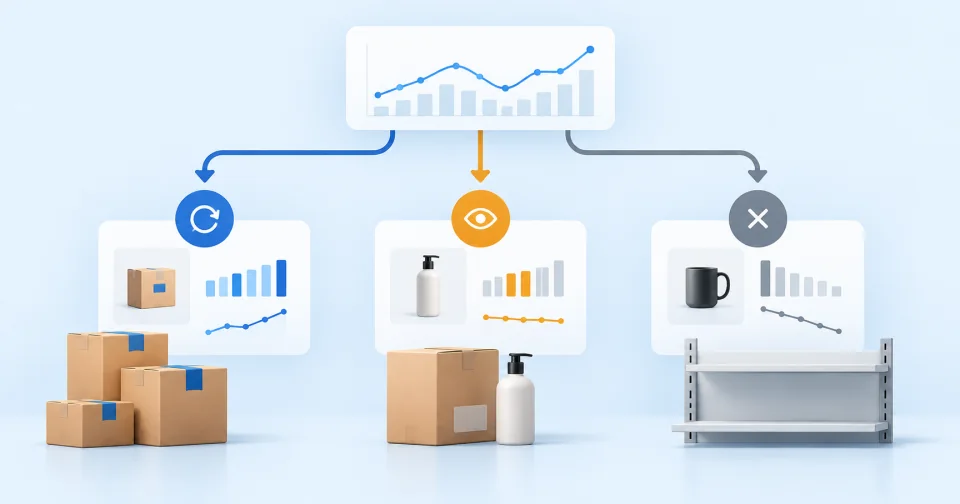
Inventory purchasing has a cost on both sides. Order too little and a strong product may be unavailable just when customers want it. Order too much and cash remains locked in goods that move slowly or not at all. A useful decision therefore starts by separating the roles products play, not by opening a single best-seller list.
Start by separating two different kinds of inventory
A replenishable product can be bought again under reasonably predictable conditions. It has observable sales velocity and a supplier that can deliver it again. The useful question is whether today’s stock will last until the next delivery.
A unique item, limited release or irregularly available product behaves differently. Selling out might not be a failure that can be fixed with another order. A long time to sale does not by itself prove a bad purchase when the item adds breadth to a collector’s range or brings the right buyer to other products.
The first filter is therefore not “selling or not selling”, but whether the item can genuinely be replenished, whether the store intends to keep it in stock and whether it serves another role such as range breadth, scarcity or a useful add-on.
Without that separation, good data becomes bad advice. A unique item receives a meaningless reorder flag and a slow add-on may be removed even though it supports the main product.
When an item runs out and how much cash it holds
Two questions are useful for a replenishable item:
- When might it run out? Divide current units by observed daily sales.
- How much cash is already sitting in it? Multiply current units by the actual unit cost.
The first shows availability risk. The second shows the cost of holding too much. Neither is sufficient alone.
Shopify’s official analytics works along similar lines, with sell-through rate, days of inventory remaining and inventory value. Its ABC grades, however, are based only on revenue at retail price excluding discounts, and ignore product cost. An ABC grade is therefore a good attention filter, not a ready-made purchasing decision.
Inventory cost is not guaranteed future revenue either. The IAS 2 accounting standard measures inventory at the lower of cost and net realisable value – what the goods will realistically fetch after the costs of selling them. How to split the cash in slow stock by age is covered in How much money is tied up in stock that barely moves.
Calculate daily velocity only from days when the item was in stock. Out-of-stock days would understate demand for exactly the goods that are running low. With only a few sales, do not produce a precise reorder date: a small sample gives a precise-looking but unstable estimate.
Lead time changes the priority
Two products can have the same days of inventory remaining and a very different risk. One supplier can deliver tomorrow; another needs six weeks. The first item can wait while the second needs an earlier decision.
A simple decision point compares estimated days of stock with supplier lead time plus a sensible allowance for uncertainty.
That allowance should not be a universal percentage. It grows where demand or deliveries vary more and where a stockout really hurts. A reorder point without spreadsheet theatre shows how to calculate it.
If lead time is unknown, say so. A system can show that a best seller is running low, but without knowing when and in what minimum quantity the supplier can deliver, it cannot honestly say how much to order.
See where cash is standing still in inventory
Korzaro combines availability, sales velocity and inventory cost into priorities you can review.
A stockout is not always a whole lost order
A customer facing an unavailable item does not have to leave. They may delay the purchase, choose another variant or brand, or buy from a competitor. Research modelling stockout-based substitution shows that willingness to switch changes the share of demand met, both for the individual item and for the whole category.
A stockout on a product with a good substitute therefore hurts less than one on a distinctive item that brought the customer to you. Yet sales of the substitute can also hide the true demand for the missing product. Ordinary order data shows only the switch to a substitute, not a delayed purchase or a customer lost to a competitor. A best seller only earns while it is in stock explains how to estimate the lost sales honestly, as a range.
Four queues instead of one ranking
After combining product role, sales velocity, stock, lead time, margin and cash tied up, place items into four working queues.
Reorder
The item is replenishable, demand is reasonably stable, margin is acceptable and stock is unlikely to last until the next delivery. High commercial value and weak substitution increase the priority.
Hold for now
Stock is adequate or the evidence is still immature. This includes a new item, a seasonal product before its relevant period or a product where a quick decision would rest on only a few orders.
Actively sell through
Material cash is tied up, the item has barely moved and no other role is supported by evidence. Selling through does not have to mean a blanket discount. Better visibility, repaired content, a relevant bundle, a supplier return or a targeted offer may be the better first action.
Do not reorder
Neither demand, margin nor commercial role justifies more capital. The decision is about the next purchase; on its own it does not say how quickly, or at what price, to clear the current stock.
What to do now
- Separate replenishable items. Do not put unique, limited and deliberately scarce goods into the same reorder ranking.
- Rank cash, not units. Start with items carrying the highest current cost value and add time since the last sale.
- Add velocity and in-stock days. For replenishable items, calculate sales only across periods when the product could actually be bought.
- Add lead time and margin. Without them, do not present a precise order quantity.
- Create four queues. Reorder, hold, sell through and stop buying. Review the first items with the largest financial effect each week.
Korzaro combines current inventory cost, time since the last sale, observed sales velocity and availability. It can surface replenishable products at risk and items where capital has been standing still. Supplier lead time and the final order quantity still require a human decision.