
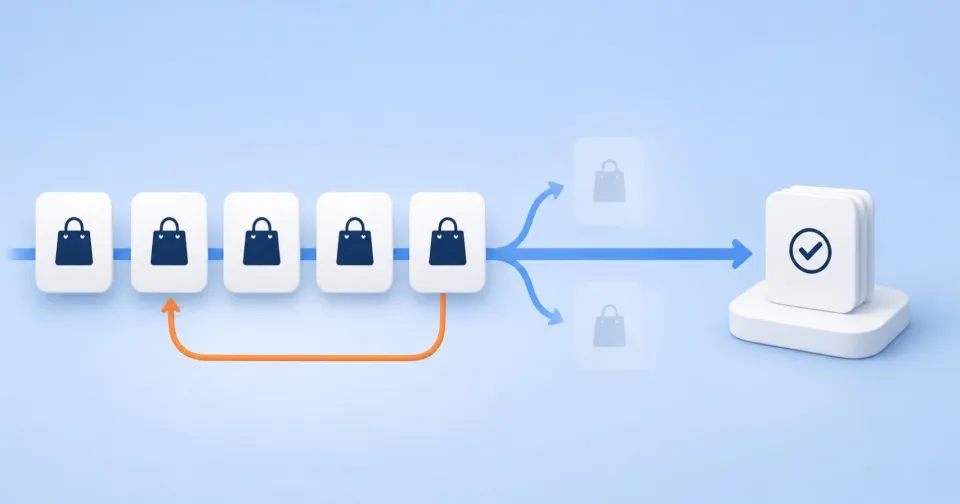
The number and value of orders are the first figures an online store owner sees each morning. They often decide which product to reorder, which channel to push and which month went well. Yet between a new order and the money the business keeps lie cancellation, payment, parcel collection and returns. If these losses differ between the things you compare, an apparently stronger product, channel or period can actually be the weaker one. For decisions, compare completed value – the value of orders after cancellations, unpaid and uncollected orders and returned goods – not the value of orders created.
Four places where an order leaks away
Between the moment an order is created and money in the bank, value can drop out in four places:
- Cancellation before dispatch. The customer changes their mind, the goods are out of stock, or the order was a duplicate or a test.
- Unpaid order. With bank transfer, the order exists but the payment may never arrive. In Shoptet, the Czech e-commerce platform, the Paid flag is not linked to whether money actually reached the account; it is set by switching the order to a particular status.
- Uncollected parcel. With cash on delivery, the store packs the goods, pays for shipping and waits to see whether the customer collects. Shoptet itself recommends moving an order to Completed only as the last step after actual delivery, that is after later events such as receipt of the cash-on-delivery payment. An undelivered order can end as Cancelled.
- Returned goods. Under Czech law, a consumer can withdraw from an online purchase within 14 days, counted for goods from receipt. They must then send the goods back within 14 days of withdrawing, and the store refunds within 14 days – but need not refund before it receives the goods or proof they were sent. Withdrawal is possible even before delivery. If a store offers a longer return window, the value of an order stays uncertain for longer.
Accounting applies the same principle. Under the international standard IFRS 15, a sale with a right of return does not recognise revenue for goods expected to come back; a refund liability is recorded instead. Small Czech stores mostly follow Czech accounting rules rather than IFRS, but the management logic is the same: while goods can still come back, the value of the order has not been earned.
Why this changes comparisons of products, channels and periods
The losses between order and revenue are not spread evenly. They vary with the payment method, the type of goods, the channel the customer came from and what the ad or product page promised. Deduct cancellations and returns in only some places, or not at all, and you are comparing unlike with unlike.
An illustrative example with invented numbers, two channels with the same ad spend of CZK 30,000 a month:
| Channel A | Channel B | |
|---|---|---|
| Value of orders created | CZK 200,000 | CZK 240,000 |
| Cancelled, unpaid and uncollected orders | 4% = CZK 8,000 | 12% = CZK 28,800 |
| Returned goods | 5% = CZK 10,000 | 18% = CZK 43,200 |
| Completed value | CZK 182,000 | CZK 168,000 |
| Ad spend / orders created | 15.0% | 12.5% |
| Ad spend / completed value | 16.5% | 17.9% |
By orders, channel B looks a fifth bigger and cheaper. After cancellations and returns it delivers about 8% less completed value than channel A, and each completed koruna costs it more advertising. The example does not yet include shipping both ways or the work of handling a returned parcel, which make returns more expensive still.
The same trap applies to periods. Orders from roughly the last five weeks are not closed yet: on top of delivery come two weeks to withdraw, two more to send the goods back, and the return journey to the warehouse. A “this month versus last month” comparison therefore flatters the month just ended, because last month’s cancellations and returns have already come through. Either compare periods of the same age, or state clearly that the recent period is not closed yet.
Ad platforms count the order, not the completed sale
Ad platforms see a purchase when the customer completes the order. Sklik, the Czech search ad platform, counts a conversion on the day its conversion code records it on the thank-you page and recommends passing the order value as the conversion value. Google Ads lets you retract a conversion for a cancelled or returned order, or restate its value after a partial return, but only if the store actively sends these adjustments.
Shoptet offers a connection that regularly sends cancelled orders to Google Ads. It is available only on the Shoptet Premium plan, requires scheduled uploads to be set up in Google Ads and handles cancelled orders, not partial returns. Without such an adjustment, even an order that was never paid stays in the ad reports.
If the store does not send cancellations and returns to the ad platform, the cost-to-revenue ratio based on its conversions looks better than the ratio based on completed value. The gap is largest for channels with a high share of cancellations or returns.
Sales and ad spend in one place
Korzaro connects your store data with your ad accounts, so ad spend can be set against what the store actually sold.
An unusual cancellation or return is a lead, not a verdict
Deducting cancellations and returns is the first step. The second is to notice where they are unusually high and trace what they are tied to. Usually it is one of three causes.
The product. Returns cluster around one item, size or variant. Research on data from a large online retailer of electronics and furniture found that reviews rated above a product’s long-term average increase purchases but also returns. The authors explain this by unmet expectations: the customer expects more than they get.
The promise. Returns or cancellations rise after a campaign, a promotion or a change in product copy. A study of free-shipping promotions found that they encourage riskier purchases and raise the overall return rate. The authors’ simulation showed that, for the firm studied, they were unprofitable once returns and lost shipping revenue were counted. How free shipping can pay for itself is covered in What actually remains from one order. An inaccurate photo, an “in stock” label that is not true, or a discount code after which cancellations or returns rose are worth checking in the same way.
An operational step. Cancellations pile up with one payment or delivery method, uncollected parcels with one carrier, cancellations for missing stock after a certain date. That is no longer a marketing question but a process one.
Beware the opposite conclusion. A meta-analysis of 21 papers showed that more lenient return policies on average increase purchases more than returns. A higher return share is therefore not a bad decision in itself. What matters is what remains after returns are deducted, not how high the share is.
What the data cannot show
An order status is only as good as the way the store uses it. Shoptet has four system statuses – Unprocessed, Processing, Completed and Cancelled – and the store creates any others itself. If orders are moved to Completed at dispatch, or uncollected cash-on-delivery parcels are not cancelled, a status filter will show more than the store actually sold. A partial return inside a completed order is not captured by the status at all.
Treat reasons with the same care. An order status tells you the order ended in cancellation, not why. If nobody recorded the reason for a cancellation or return in a note, form or code, do not fill it in by guesswork. “Customers return because the size is wrong” is a hypothesis to test on a sample of real cases, not a conclusion from a table.
What to do now
- Find out how the store uses statuses. Check when an order moves to Completed, whether unpaid transfers and uncollected cash-on-delivery parcels are cancelled, and where returned goods are recorded.
- Put created and completed value side by side. Shoptet’s overall statistics can be filtered by order status and shown excluding VAT. Compare both figures for the products, channels or periods you are weighing and see whether the ranking changes.
- Compare periods of the same age. Mark recent weeks as not closed until the return period has passed.
- Recalculate ad spend against completed value. Not against the conversions the ad platform credited to itself.
- Trace unusual cancellation and return shares. Split them by product, campaign, payment method and carrier, and establish the real reason for a handful of specific orders.