
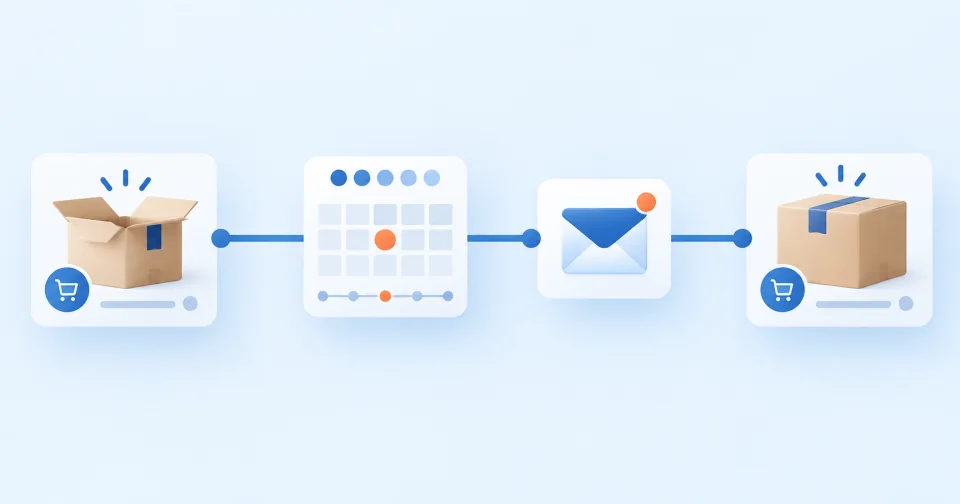
After a first order, do not begin by asking how many emails an automation should contain. Begin with when the customer might genuinely need something again and whether the first order went well enough for them to want to return. Then choose one useful next step and measure it on a customer group that has had enough time to make a second purchase.
The second purchase does not start with an email
A customer’s decision to return is already taking shape before a reminder arrives. It depends on whether the product matched its description, the order arrived as promised and any problem was resolved without unnecessary friction.
A study of a Western European service delivering groceries within minutes makes the point clearly. The authors analysed more than 1.7 million intervals between orders and added a controlled online experiment. After a late delivery, customers waited longer before ordering again, and the experiment showed that the effect runs through lower satisfaction. This is delivery measured in minutes, though, not a model for every online store.
The practical conclusion is not “deliver everything faster”. It is to check whether the first experience repeatedly breaks the promise before optimising a second-purchase campaign. Marketing cannot reliably cover for recurring delays, unclear instructions, a difficult return or a product that failed to meet expectations.
Let the assortment set the timing
Research on durable goods and large-scale online grocery data agree: the time to the next purchase depends on the nature of the product, the buying situation and the customer’s own rhythm. One delay cannot therefore be right for cosmetics, coffee, children’s shoes and a collectible coin at the same time.
For a consumable product, a replenishment reminder may be useful close to the point when the product normally runs out. For a product with a natural accessory, it may be better to help the customer use the original purchase before presenting a genuinely related addition. A durable or collectible item may not have a useful short repurchase window at all. The reason to return might then be new content, the availability of a particular item or service rather than pressure to order again quickly.
The median is a reference, not an alarm for everyone
The typical time to a second order is a useful starting point, but it is not an automatic send date. A median describes customers who have already returned. It does not show that the same moment is appropriate for everyone after their first order.
Read it alongside the spread and the category of the first purchase. If one large group returns after four weeks and another after six months, a single figure lands somewhere in between and suits neither. When there are only a handful of second purchases, do not choose timing yet; one order can move the result by weeks.
Offer the next useful step, not a compulsory discount
The first post-purchase contact does not have to sell anything. It can make it easier to use the product, find instructions, track the parcel, reorder or resolve a return. A relevant product, replenishment or service belongs only where there is a natural continuation.
This is more than a question of tone. In a field experiment on an e-commerce platform, a seller offered customers cash back for a favourable review. Larger rewards got more people to write one, but customers who received the offer bought again substantially less often than a control group, whatever the reward size. The result should not be generalised to ordinary review requests or to the Czech market. It does show the boundary: a post-purchase incentive is not necessarily valuable to the customer and can weaken trust.
Frequency deserves the same restraint. In a 2026 Baymard Institute survey of 1,083 US online shoppers, emails arriving too often from a particular retailer were the most common stated reason for unsubscribing (48%), just ahead of general inbox overload (46%). This is self-reported behaviour rather than a Czech experiment, but it is a useful brake when designing an automation.
See how your customers actually return
Korzaro brings your store data together and shows what deserves attention each week.
Measure a first-purchase cohort, not a campaign dashboard
Start with customers who share the same beginning, such as everyone who placed their first order in one month. Then measure how many made a second order within a window that matches the assortment. Shopify’s customer cohort report follows the same structure: customers are grouped by their first order and repeat purchases are tracked in later intervals.
The most important rule is not to compare an incomplete window with a complete one. Last month’s cohort has not yet had six months in which to make a second purchase. A zero in that situation is not failure; it is missing time.
For a first test, track four things:
- the share of customers with a second order in a completed window;
- the typical time to that second order;
- the margin or contribution of the second order, not revenue alone;
- side effects such as unsubscribes, complaints and returns.
Splitting by the category of the first purchase is often more useful than one store-wide result. But when this produces groups of only a few customers, step back to a broader category. A precise segment without enough volume is merely a precisely presented accident.
Association is not an incremental effect
If customers who open an email buy more often, that does not mean the email made them buy. More active customers are both more likely to open messages and more likely to buy. Revenue that the email tool credits to the message does not remove that difference.
If volume allows, keep a small randomly selected control group that does not receive the new contact and compare the same observation window. Randomised experiments are the standard way to separate the incremental effect of a marketing intervention from what would have happened without it. A small store may not have enough volume for a conclusive experiment; in that case, describe the result as an association rather than certainty.
Commercial email has legal boundaries too
A useful message still has to be lawful. Without consent, Czech law lets you email a customer whose address you obtained in connection with a sale only about your own similar products or services. The customer must be able to refuse simply and free of charge when the address is collected and in every later message; the EU directive behind the Czech rule sets the same baseline. Assess a specific automation by its content, the origin of the address and whether the offer genuinely concerns similar goods. This is orientation, not legal advice.
What to do now
- Choose mature cohorts. Group customers by the period of their first purchase and use only cohorts that have completed the full observation window.
- Find the buying rhythm. View the time to the second order for the store and for a few important first-purchase categories.
- Check the first experience. Look for recurring delays, returns, questions or confusion that another marketing message cannot hide.
- Choose one contact. Give one sufficiently large group one useful next step at a time supported by its data.
- Review a completed window. Track the second order, return time, margin and negative signals. Without a control group, describe association rather than effect.
Korzaro shows first-purchase cohorts and the typical time to a second order using the store’s order data. That means the first automation can be timed from how your customers actually return, not from a generic template.